
Most people don’t think about their windows until one starts letting in cold air, or they’ve got one over the sink they can barely reach to open. Then the question arises: should you stick with a standard window or step up to a casement window?
This blog walks through both, covering how each seals, how each opens, what each runs, and where each belongs. By the end, you’ll know which fits your place.
The difference between casement vs. standard windows
A casement hangs on a side hinge and swings out like a door. You open it with a crank instead of sliding a sash. We build custom casement windows to the exact size of your window opening, which is why we use them for odd dimensions, older framing, or when someone wants a single pane of glass for the view instead of a bar across the middle.
Standard windows are what most homes already have. Double-hung windows have two sashes that slide up and down, while sliders move side to side. Both come in stock sizes, so they’re cheaper and quicker to get.
The difference comes down to how each one closes. A casement cranks tight against weatherstripping on all four sides. A standard window seal where one sash slides past another, and that joint lets more air through. It lets through more as the window ages and the hardware loosens.
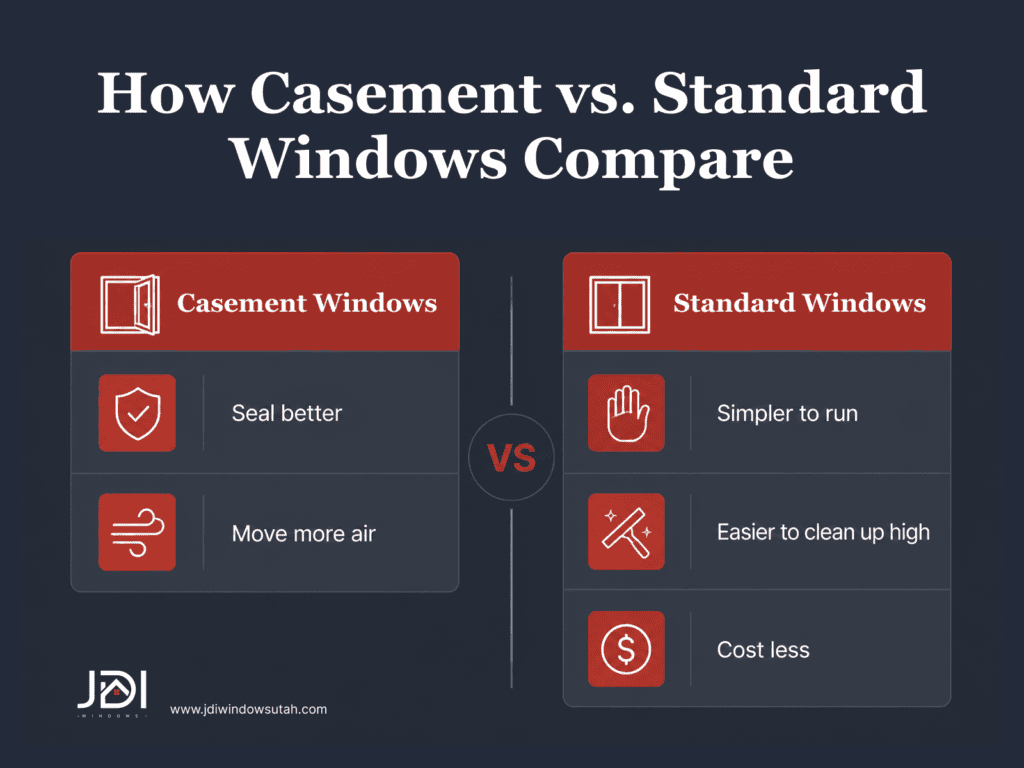
How casement vs. standard windows compare
Here’s the side-by-side.
Casements seal better. The four-sided seal keeps drafts out better than a sliding sash does. In winter, when the wind comes down the canyons, you feel that through the glass.
Casements move more air. They open the whole pane, and you can angle them to catch a breeze. A standard window only opens half its opening at a time, so you get about half the airflow.
At the same time, standard windows are simpler to run. You push them by hand. There’s less hardware, so there’s less to adjust or replace down the road. A casement’s crank is easy over a sink or counter, but it’s one more moving part.
Standard windows are easier to clean up high. Double-hung windows tilt in, so you clean both sides from inside, which is handy on a second story. A casement you crank open and reach around the outside, which is more of a stretch.
Finally, standard windows cost less. The different parts and custom sizing add to the cost of a casement. How much depends on frame material, glass, and size, so ask for the quote broken down line by line.
Where each one belongs
We recommend using a casement window in the following situations:
- When you want the tightest seal and the most air
- When the opening is an odd size that a stock window won’t fill
- Over a kitchen sink, where a crank is easier than a shove
- When you want one clean pane on a view
Use a standard window with these considerations:
- When the budget is the main thing
- When the window opens over a walkway or patio
- Where an outward swing would be in the way
- When the room runs on a window-unit AC
A traditional look on an older home is another good reason to stick with the standard. A casement won’t take a window AC. Since it swings out, there’s no flat surface to set the unit on.
Where people go wrong
We see a few issues when customers decide which window works best for them:
- People put a casement where it swings out over a walkway or patio. Then it’s in the way every time someone passes.
- People think custom means a long wait. It doesn’t. The opening gets measured, the window gets built to it, and a good shop turns it around without much extra time.
- People skip the frame material conversation. Vinyl, fiberglass, and wood each handle our freeze-thaw swings differently, and that choice matters more than crank versus slide.
- People buy on sticker price alone. The cheapest standard window loses more in air leakage over ten winters than it saved the day it went in.
What the energy side tells us
The U.S. Department of Energy points to windows as a major pathway for heat moving in and out of a house, and to air leakage around and through them as a major contributor to that loss. Cut the leakage, and you cut the bill. That’s where a casement’s seal has the edge over a sliding standard window.
One thing worth saying plainly: the seal only works if the install is right. A window set square, flashed, and sealed does its job. A rushed install gives the advantage back, no matter which style you bought. The install moves your energy use more than the style does.
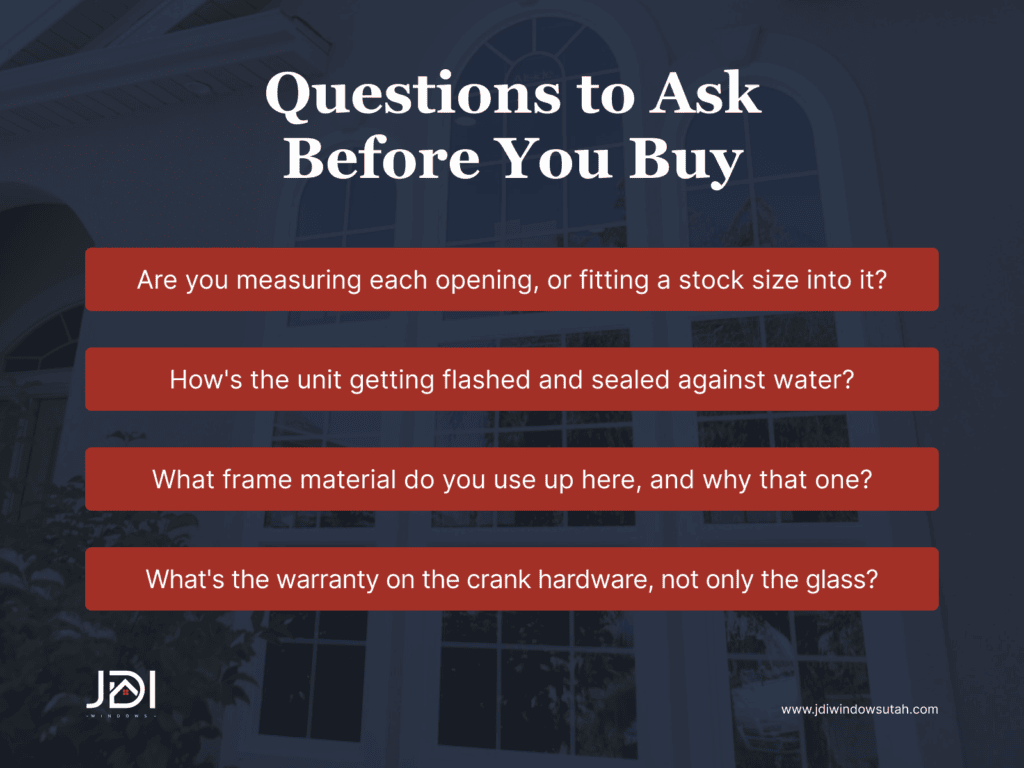
What to ask before you buy
Casement window installation comes down to the details, so ask whoever’s quoting you:
- Are you measuring each opening, or fitting a stock size into it?
- How’s the unit getting flashed and sealed against water?
- What frame material do you use up here, and why that one?
- What’s the warranty on the crank hardware, not only the glass?
Frequently asked questions
Q: Do custom casement windows cost more than standard windows?
Usually, yes. The crank, the hinges, and the custom sizing add up. How much depends on size, frame, and glass. Ask for a written, itemized estimate.
Q: Can I put a window AC unit in a casement window?
No. It swings outward, so there’s no flat opening for the unit.
Q: Is casement window installation harder than a standard window?
It takes more care. The unit has to sit square and sealed so the crank runs smoothly and the seal actually seals. It’s routine work for us, but it’s not the place to hand the job to the lowest bidder.
Q: Which lasts longer, casement or standard?
Both go decades when they’re put in the right way. A casement has moving hardware that’ll want adjusting eventually. A standard window has fewer parts. Frame material and install quality decide this more than the style does.
Why does it matter more in Utah?
Utah weather puts a sharper point on the sealing question than milder places deal with. Along the Wasatch Front, winter wind and hard freezes drive air through any gap they find, so a casement’s tight seal earns its keep on the coldest nights. In homes at elevation, the freeze-thaw cycle wears down frames and seals season after season. That’s why the frame material and a clean install matter as much as which style you pick.
Call JDI Windows today
Whether you opt for custom casement window installation, standard windows, or a mix throughout the house, JDI Windows can set you up with the right fit. We install both, all day, every day, so when we walk your place, we’re telling you what actually works for each room, not steering you toward whatever’s easiest to sell.
Whether it’s a casement over the kitchen sink or standard windows in the bedrooms that run a window AC through July, we’ll sort it out with you, one window at a time.
We’re local and licensed, and we’ve been up on the ladder in homes all along the Wasatch Front. That means we know how these windows hold up through our winters and what our freeze-thaw swings do to a seal over time. When we quote you, it’s broken out line by line, so you see exactly where the money goes and why.
Give JDI Windows a call, and we’ll take a look at your openings, talk it through, and get it done right the first time.